 EN
EN
How Rubber Cart Wheels Absorb Shock on Rough Terrain
The Science of Elastic Deformation and Energy Dissipation in Rubber
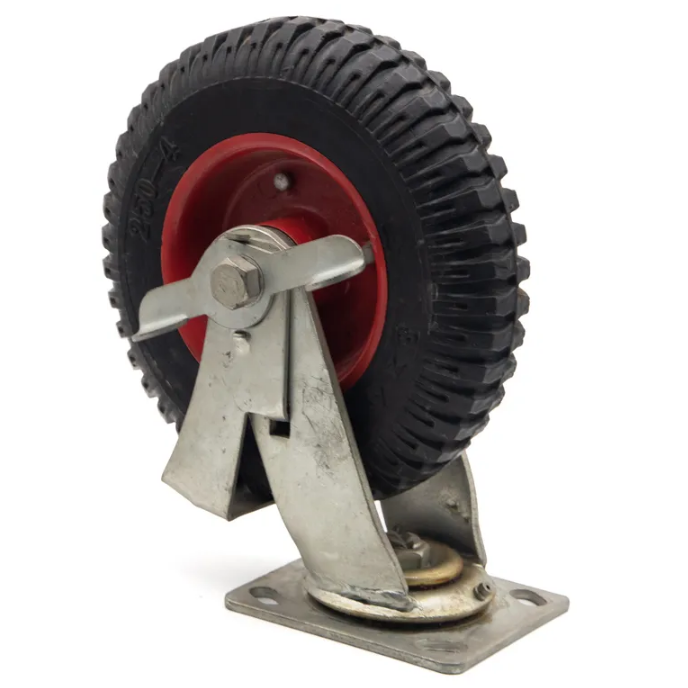
Rubber cart wheels absorb shock through elastic deformation—a reversible compression and stretching enabled by their polymer chain structure. When rolling over bumps or rocks, the rubber deforms temporarily, converting kinetic energy from impact into heat via internal friction (hysteresis). This process safely dissipates energy instead of transmitting it to the cart frame or load. As a result, rubber wheels support up to 450 kg per wheel while delivering a smoother, quieter ride on uneven terrain—protecting both equipment integrity and cargo stability.
Rubber vs. Polyurethane vs. Hard Plastic: Measured Vibration Reduction in Real-World Field Tests
Field testing confirms rubber’s superiority in vibration damping: it reduces transmitted vibration by up to 60% more than polyurethane on rough ground, and significantly more than hard plastic, which transmits nearly all surface impacts. While polyurethane prioritizes abrasion resistance and high-load performance, and hard plastic offers rigidity at the cost of comfort, rubber’s inherent elasticity absorbs shocks before they reach the axle. For outdoor applications—such as moving tools across dirt, gravel, or grass—rubber delivers unmatched ride quality, control, and operator comfort.
Rubber Cart Wheels Maximize Traction Across Challenging Outdoor Surfaces
Rubber cart wheels provide superior grip on loose and uneven surfaces due to their naturally high coefficient of friction. This is especially critical on dirt, grass, and wet gravel—surfaces where rigid casters tend to slip, skid, or dig in uncontrollably.
Coefficient of Friction Advantage: Dirt, Grass, and Wet Gravel Performance
On dry or damp dirt paths, rubber tread slightly conforms without damaging the surface, generating traction that stiffer materials cannot replicate. Its coefficient of friction remains consistently high even on dewy grass or wet gravel—conditions that reduce grip for polyurethane and hard plastic. The elastic deformation also allows the tread to wrap around small obstacles like pebbles and roots, increasing real-world contact area and minimizing slippage. This makes rubber the material of choice for garden carts, wheelbarrows, and event staging gear operating across variable, unprepared terrain.
Load-Bearing Grip: Why Rubber Maintains Contact Under Weight and Slope
Under heavy loads or on inclines, rubber wheels compress vertically, widening the contact patch and maintaining firm, continuous pressure against the ground. This adaptive conformity resists lateral slippage far better than rigid alternatives like nylon or steel, whose smaller, inflexible contact zones lose traction on gradients. In practice, rubber wheels retain stable grip on slopes up to 10 degrees—reducing operator effort, preventing load shift, and enhancing safety on demanding jobsites.
Choosing the Right Rubber Cart Wheels for Long-Term Outdoor Durability
TPR, Solid Rubber, and Pneumatic Options: UV Resistance, Debris Handling, and Corrosion Protection
Three primary rubber-based wheel types dominate outdoor applications: thermoplastic rubber (TPR), solid rubber, and pneumatic designs—each optimized for distinct environmental stressors.
For UV resistance, TPR leads due to its molecular structure’s natural reflectivity, reducing solar-induced cracking by up to 40% compared to conventional rubber compounds. Solid rubber achieves comparable longevity when formulated with UV inhibitors, whereas pneumatic tires require protective sidewall coatings to avoid degradation after prolonged sun exposure.
Debris handling differs markedly:
- Solid rubber is impervious to punctures from thorns, rocks, or glass thanks to its homogeneous, non-hollow construction
- TPR balances flexibility and puncture resistance but may retain embedded gravel in softer grades
- Pneumatic wheels deliver the highest cushioning yet remain vulnerable to sharp objects—nails, broken glass, or jagged stones can compromise air retention
Corrosion protection depends on both compound chemistry and hub engineering. TPR and solid rubber resist moisture absorption inherently; pairing them with stainless steel axles ensures long-term structural integrity. Pneumatic variants, however, trap internal moisture and demand galvanized or powder-coated steel hubs to prevent rust—especially critical in humid or coastal settings where untreated components degrade within 12–18 months. Field data shows TPR retains 95% of its load-bearing capacity after five years in coastal environments, affirming its reliability for sustained outdoor use.


