
 EN
EN
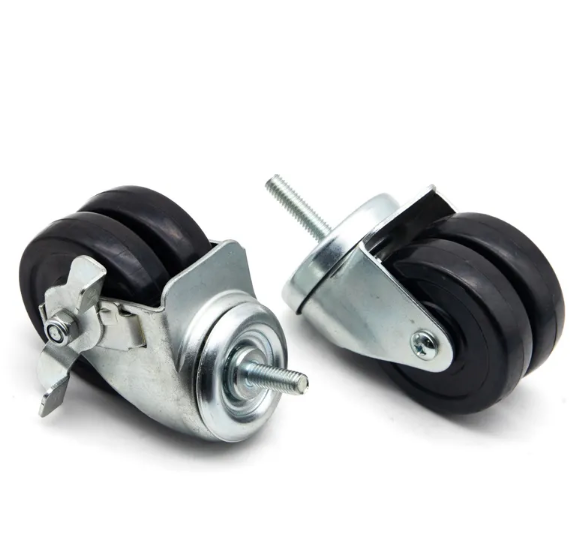
The Material Science That Actually Drives Caster Noise
Rolling noise from caster wheels isn't random. It comes from two physics-level interactions: the hardness mismatch between wheel material and floor surface, and the damping capacity of the wheel compound itself. Harder materials transmit vibration efficiently, which means surface irregularities, floor joints, and even minor debris under the wheel get converted directly into audible impact noise. Softer materials absorb that energy before it becomes sound.
Nylon sits at roughly Shore D 80-85 on the durometer scale. Polyurethane caster wheels typically land in the Shore A 85-95 range, which makes them meaningfully softer while still carrying substantial load capacity. That gap in hardness is the single biggest reason polyurethane rolls quieter, but it isn't the whole story.
How Polyurethane Absorbs Impact at the Contact Patch
The contact patch is where all the acoustic action happens. When a wheel rolls over a threshold strip, a floor tile joint, or a small piece of grit, the wheel material momentarily deforms and then recovers. In polyurethane, this deformation cycle dissipates energy as internal molecular friction rather than transmitting it outward as vibration. This property is called hysteresis damping, and polyurethane has significantly more of it than nylon.
A practical consequence: a nylon wheel striking a 1mm floor joint generates a sharp click that travels through the cart frame and into the surrounding air. A polyurethane wheel crossing the same joint produces a muffled thud that often stays below the perception threshold in a quiet room. Acoustic testing referenced in the Caster and Wheel Manufacturers Association (CWMA) technical literature has documented noise reductions of 8 to 15 dB between hard thermoplastic wheels and polyurethane equivalents on comparable floor surfaces.
Floor Protection as an Acoustic Side Effect
There is a related mechanical benefit worth noting. The same deformation that makes polyurethane quiet also distributes load more evenly across the contact patch, which reduces peak pressure on the floor surface. Nylon concentrates force on a narrower contact area because it doesn't deform, which generates both higher noise and greater risk of scuffing or indenting softer floor types.
| Wheel Material | Shore Hardness | Noise Level (Relative) | Floor Protection | Load Capacity | Typical Lifespan |
|---|---|---|---|---|---|
| Nylon | D 80-85 | High | Low | Very High | Long |
| Polyurethane (standard) | A 85-95 | Low | High | High | Medium-Long |
| TPR (Thermoplastic Rubber) | A 60-75 | Very Low | Very High | Medium | Medium |
| Hard Rubber | A 70-80 | Low-Medium | High | Medium-High | Medium |
| Cast Iron | N/A | Very High | Very Low | Very High | Very Long |
Nylon does retain advantages in environments with oils, solvents, or high temperatures, where polyurethane can soften or swell. That tradeoff is worth knowing: polyurethane is not a universal answer.
A Real-World Shift from Nylon to Polyurethane
During a facility equipment refresh at a university library in central China, the procurement team initially sourced nylon-wheeled book carts due to their lower unit cost. After installation, complaints from reading room staff about cart noise during reshelving prompted a material review. Rolling noise tests on the building's epoxy-coated concrete floors showed nylon wheels averaging 62-65 dB at a 3-meter distance during normal cart movement. Polyurethane wheels on the same cart frames reduced that reading to 51-54 dB under identical conditions, roughly a 10 dB drop, which correlates to a perceived halving of loudness.
The switch also eliminated scuff marks that had been appearing on the floor's surface finish, an additional maintenance benefit that hadn't been anticipated in the original analysis.
Matching Polyurethane Formulation to the Specific Application
Not all polyurethane wheels are identical. Shore hardness, urethane chemistry (polyether vs. polyester base), and core material all affect how a wheel performs in service.
1.Shore A 85-90 formulations offer the best noise attenuation for lighter-duty mobile shelving and carts.
2.Shore A 92-95 options trade some damping for higher load ratings, suited for heavier rolling equipment.
3.Polyether-based urethane resists hydrolysis better in humid storage environments.
4.Polyester-based urethane handles higher static loads with less creep over time.
Wheel core material also matters. A steel-core polyurethane wheel will transmit more vibration through the hub and bracket than a nylon-core version, even if the tread compounds are identical.
When Polyurethane Makes Practical Sense Beyond Noise
The acoustic argument is clear, but polyurethane wheels bring other properties that extend their value past noise-sensitive environments. Their grip on smooth tile and polished concrete reduces cart drift on sloped floors. Their elasticity provides some shock absorption in facilities where equipment gets moved frequently over service elevators with uneven thresholds.
The limitation to keep in mind is chemical resistance. Polyurethane wheels should not be specified for environments with regular exposure to aromatic solvents, chlorinated compounds, or sustained temperatures above 80 degrees Celsius, where nylon or other engineered polymers perform more reliably.
Yirong manufactures polyurethane caster wheels across a range of hardness grades and load ratings, with production quality backed by ISO and TUV-certified processes, making it straightforward to match formulation to application requirements without over-engineering the specification.
Table of Contents
- The Material Science That Actually Drives Caster Noise
- How Polyurethane Absorbs Impact at the Contact Patch
- Floor Protection as an Acoustic Side Effect
- A Real-World Shift from Nylon to Polyurethane
- Matching Polyurethane Formulation to the Specific Application
- When Polyurethane Makes Practical Sense Beyond Noise


