
 EN
EN
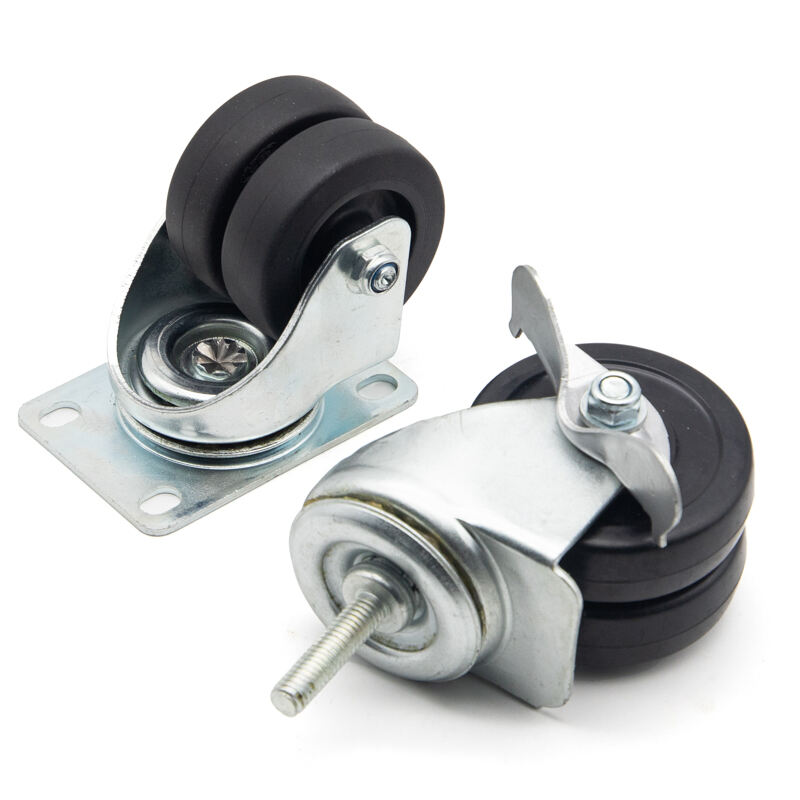
Load Capacity and Dynamic Stability of Caster Wheels
Matching Caster Wheel Load Ratings to Rack Weight Profiles and Safety Margins
When choosing caster wheels, it's important to match their load ratings with what the storage rack actually weighs. There are two main things to consider here: static load capacity, which is how much weight they can hold when still, and dynamic load capacity, referring to what they can handle while moving around. These are different but equal factors. According to industry standards like ANSI/MH10.4 and ISO 21873, the static rating needs to be about 25% higher than whatever each caster will carry at rest. For dynamic loads, manufacturers recommend allowing for roughly double that safety margin, because casters face extra stress from starting up, stopping suddenly, and dealing with bumps or cracks in floors. Most experienced warehouse managers know this isn't just theoretical stuff; it makes a real difference in equipment longevity and workplace safety.
To figure out what rating each wheel needs at a minimum, just do this math: take the total weight of the rack and divide it by how many casters there are, then multiply that number by the safety factor. When things stay put most of the time, like equipment mounted on staging platforms that don't move around much, go with a safety factor of 1.25. But if the rack gets moved frequently from one spot to another during operations, bump that up to 1.5 instead. Let's say we have a standard 2000-pound rack sitting on four wheels. With our basic math, that works out to about 625 pounds needed per wheel when stationary. However, when moving regularly, each caster actually needs to handle around 750 pounds to keep everything running smoothly without failures.
| Load Type | Primary Stress Source | Recommended Safety Factor |
|---|---|---|
| Static | Gravity-only compression | 1.25 — total rack weight |
| Dynamic | Momentum, inertia, and floor irregularities | 1.50 — total rack weight |
Preventing Tip-Over: Center-of-Gravity Alignment and Swivel Lock Integration for Rack Stability
Stability begins with load placement: position heaviest items on the lowest shelves to lower the center of gravity—this single adjustment reduces tip-over risk by up to 40% during transport, as confirmed in OSHA-compliant material handling audits. Pair this with three proven engineering controls:
- Swivel locks: Engage before straight-line movement to eliminate unintended rotation and pivot-induced instability
- Strategic caster configuration: Front swivel + rear rigid casters deliver optimal directional control without sacrificing maneuverability—validated across warehouse ergonomics studies
- Dual-wheel assemblies: Increase lateral stability by widening the effective wheelbase, especially critical for racks over 6 feet tall
Always conduct a pre-move stability test: shift load incrementally while stationary to identify balance thresholds. Maintain a minimum 3-inch wheelbase extension beyond the outermost load edge to ensure footprint alignment and prevent edge-loading stress on casters.
Caster Wheel Configuration: Swivel vs. Rigid and Mounting Compatibility
Directional Control vs. Lateral Rigidity: When to Use Swivel or Rigid Caster Wheels
Swivel casters can turn all the way around 360 degrees, which makes them great for making tight turns and moving in any direction. They work especially well in storage areas where the aisles are less than eight feet wide. On the other hand, rigid casters stay pointed in one direction. These provide better straight-line movement, less wobbling from side to side, and stand up better against sideways pressure when carrying really heavy stuff over 1,000 pounds per wheel. Most people in the business recommend using a mix of both types for mobile racking setups. Put swivels in front for easy maneuvering and rigids at the back for stability when going straight. What kind of floor matters too. Swivel wheels need clear space to move properly, so they tend to get stuck on floors with cracks or bumps where the concrete rises slightly above surrounding areas.
Plate Mount and Stem Mount Caster Wheels: Ensuring Structural Integrity and Frame Clearance
How something gets mounted makes all the difference when it comes to how weight moves through the system and what happens to the frame in the long run. Plate mount casters spread out the pressure over a wide steel surface area and fasten right into those reinforced spots on the rack frame. These are really the go-to choice whenever dealing with weights over 800 pounds per caster. Stem mount versions, whether they're threaded or have those grip rings, work better for racks with round legs where there's limited headroom. But here's the catch—they don't hold up as well when forces come from unexpected angles. When installing, make sure the mounting points line up exactly with those main load-bearing connections, not just any old part of the frame tubing. Also, check that there's at least a quarter-inch gap between the caster parts and anything hanging below. Getting this wrong leads to faster wear and creates twisting forces that slowly weaken the whole rack structure over months or years of use.
Caster Wheel Material, Size, and Tread Design for Floor-Friendly Mobility
Polyurethane, Rubber, and Nylon Caster Wheels: Trade-offs in Durability, Noise, and Surface Protection
Material selection governs performance across durability, acoustics, and floor compatibility—each with clear application boundaries:
- Polyurethane: Offers the best overall balance—excellent abrasion resistance, moderate noise (65–70 dB at 3 mph), and non-marking performance on concrete, epoxy, and VCT flooring. Preferred for mixed-use environments per ASTM F1979 impact testing.
- Rubber: Delivers superior vibration damping and near-silent operation (<55 dB), but degrades faster under sustained loads >500 lbs or exposure to oils and UV. Best reserved for light-duty, climate-controlled spaces with wood, tile, or polished concrete.
- Nylon: Unmatched chemical and moisture resistance—ideal for labs, food processing, or washdown areas—but transmits significant noise ( ≈ 80 dB) and may indent soft flooring under point loads. Requires strict adherence to rated capacities to avoid permanent deformation.
Optimizing Caster Wheel Diameter and Tread Width for Tight-Space Maneuverability and Load Distribution
The shape and size of wheels really matter when it comes to transferring force from racks down to the floor surface, plus affects how smooth things go for folks moving around tight spaces. Wheels with smaller diameters, say between 3 and 5 inches, work great in those super narrow aisles under six feet wide. They give nice responsive steering and let equipment turn on a dime, but there's a catch. These small wheels put all the weight into such a tiny area that they can actually leave marks or indentations on softer flooring materials like vinyl or rubber surfaces. On the flip side, bigger wheels ranging from about 6 to 10 inches plus perform better when rolling across rough terrain with cracks, expansion joints, or bits of debris scattered around. The larger contact area spreads out the weight more naturally, which means less stress points on the floor. Some tests show this can cut down peak pressure against the floor by somewhere around 30 to 35 percent, making these bigger wheels worth considering for facilities concerned about floor damage over time.
Tread width further refines performance:
- ≠ 2-inch treads significantly reduce psi on sensitive surfaces—essential for epoxy-coated or thin-VCT floors in distribution centers
- < 1.5-inch treads enhance agility in confined spaces but demand reinforced subfloors and strict load compliance to prevent edge-cutting or gouging
Always cross-reference wheel dimensions against both rack weight distribution and aisle clearance—undersized wheels increase operator fatigue and floor damage; oversized ones compromise stability in tight layouts.
FAQ
What is the recommended safety factor for static loads on caster wheels?
The static safety factor is recommended to be about 1.25 times the total rack weight to ensure stability when stationary.
How do swivel locks improve caster wheel stability?
Swivel locks prevent unintended rotation during straight-line movement, thus reducing the risk of tip-over and enhancing stability.
What is the main advantage of using polyurethane caster wheels?
Polyurethane wheels offer excellent abrasion resistance, moderate noise levels, and non-marking performance, making them suitable for mixed-use environments.
Why should racks over 6 feet tall use dual-wheel assemblies?
Dual-wheel assemblies widen the effective wheelbase, increasing lateral stability, which is crucial for taller racks to prevent tip-overs.


